We began our journey home with a sixteen hour train ride from Weihai to Beijing. Spaces in the more comfortable "soft bed" compartment were not available, so we rode in the three tier "hard bed" section. In deference to my age and notorious clumsiness, my companions gave me the lowest berth. Bolstered with quilts, the beds weren't really uncomfortable, and I actually prefer it to flying.
The others slept reasonably well. I however, had developed the traveler's trots and spent much of the night squatting over a Chinese toilet, attempting to tidy things up with a whisk broom, the only implement on hand for this purpose.
I was a professor of curriculum and instruction at East Tennessee State University and am now in emeritus status. Currently, I teach English composition part-time at George Mason University. I have taught in Cincinnati, Turkey, China and the Czech Republic.
Sunday, March 22, 2015
Monday, March 16, 2015
Mission Accomplished
Yesterday, the cooperation agreement with the University of
Shandong was finalized with a ceremonial signing and the exchanging of gifts
before the flags of both countries. Afterwards,
there was a ritual banquet.
Such formality is
considered essential to make things official, but since I am inclined to be
snarky, I wondered if we were negotiating nuclear disarmament or academic
exchanges.
The objectives of this project were to further develop our
relationship with North China Institute of Commerce and Technology, to
establish a new partnership with Shandong Institute of Commerce and Technology,
and to formalize a new program at Shandong University, Weihai. Successful with all of them, we begin our
journey home to the States later today.
Great Firewall
This is the downside of being in China. For the last 24
hours, I have been shut out of email. Even the brand new address Dennis Cope
created for me wasn't working. I couldn't
see any incoming mail, nor send anything.
The Internet was functioning. The problem was what is euphemistically
called “Information control”—censorship, in other words. In China, many websites are blocked, and the
minute one says anything remotely controversial, one’s email is discontinued.
It’s scary when this happens, particularly when I’m
traveling solo. Eventually, my access
reopened. It’s all made to look
completely accidental. A thousand thank
yous to Dennis Cope who manages my blog site
and runs interference.
Sunday, March 15, 2015
Memory
Yesterday, we toured the Weihai peninsula and then caught a
ferry to Linguon Island, site of many battles between the Chinese and Japanese
in both World War II and the
Sino-Japanese War. The wounds of these conflicts have not healed, and there is
still much bitterness toward the Japanese.
One exhibit tells the story of a Chinese family whose ten
members jumped down a well rather than be captured by the Japanese.
Today, this beautiful
island is peaceful with gardens, a temple, and monuments to the dead. There are
several historical museums and even a zoo.
Cable cars in an array of bright colors carry their passengers to a
pagoda at the top of the mountain.
Reverence
Yesterday, we visited the Temple of Confucius in Qufu, a
complex of ancient stone buildings with ornate doorways, courtyards, and old
trees. It is built on a hillside, and one gradually ascends to the higher
levels via stone stairs. At the Temple’s
entrance is a reminder that everyone, even the highest official ought to show
Confucius respect.
Confucius was not a god, but a teacher and social
philosopher. He lived between 551 and 480 BC, a chaotic period in the history
of China. His ethical teachings, which resemble those of all the great
religions, greatly influenced Chinese thought.
Each day, there is a ceremony at the Temple venerating the
sage. When government officials visit,
the ceremony is more elaborate, and we were fortunate to visit on one of these
days. Trumpets were sounded, and incense burned. Red robed celebrants carrying
peacock feathers brought flowers to and altar where incense burned. There is something universal about
reverence.
Saturday, March 14, 2015
Thursday, March 12, 2015
Strawberry
Fields Forever
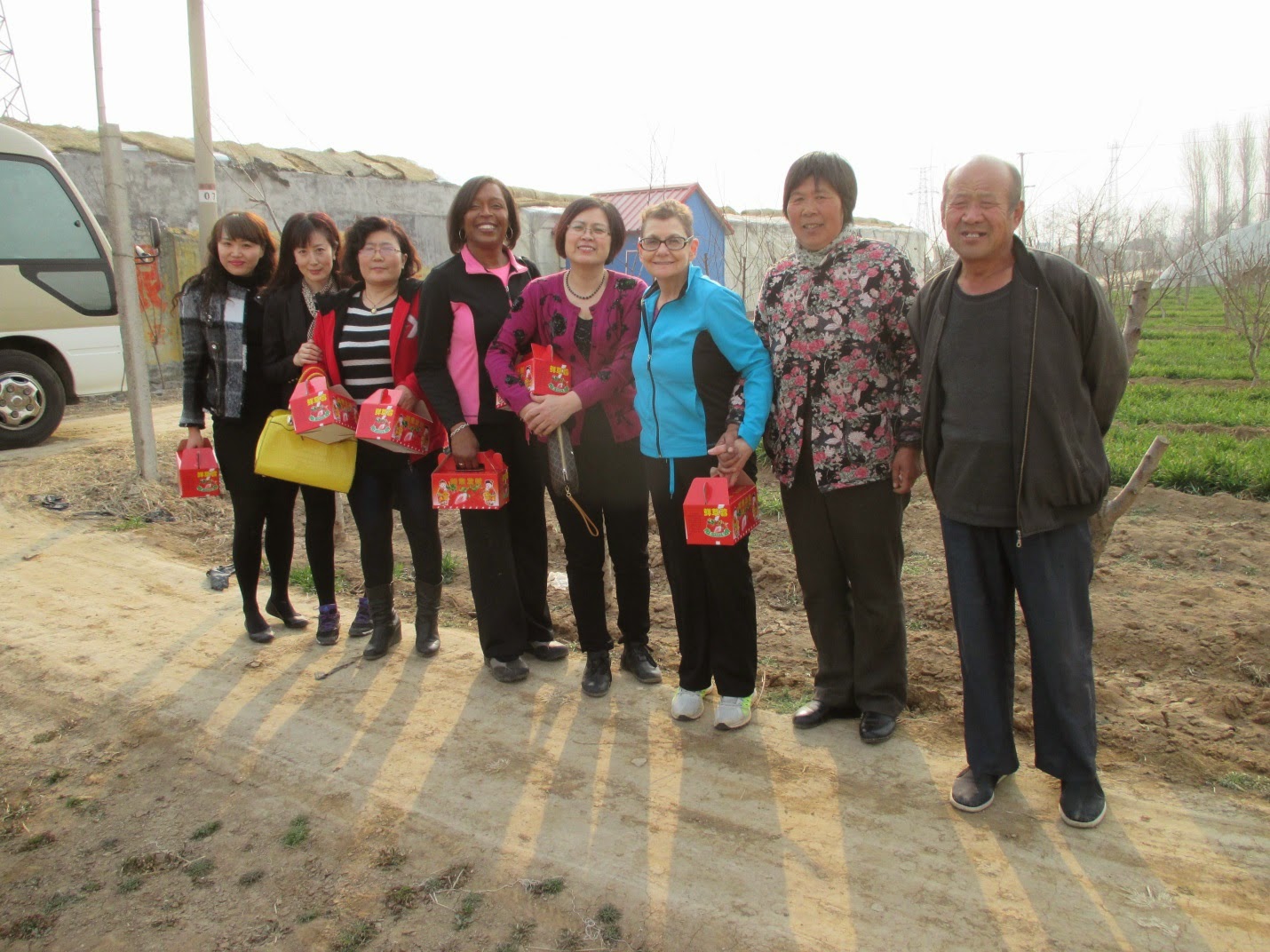
The Chinese have different attitudes toward schedules than we and change agendas at a moment’s notice. They have more authority over their students. We were scheduled to meet with some students yesterday afternoon, but it was a very nice day, and the leaders thought we ought to go strawberry picking in a greenhouse on the age of the city instead. So after the signing, they summoned the students to hear our presentations.
“Won’t this disrupt their schedules?” Dr. Lewis inquired. Well
of course it did, but these were students, and in China students do as they’re
told.
In Jinan, greenhouse strawberries are grown in the winter. They are juicy and delicious. We were told
that the farmers make a good living, thanks to government support.
Subscribe to:
Posts (Atom)
What does tomorrow mean? It is 5:30 pm here, but at home it’s 5:00 in the morning. I leave Weihai tomorrow and make a stop in Beijing. ...
-
Guanxi To understand China, one must understand the notion of "guanxi" (pronounced GWAN-SHEE). Roughly translated, it means connec...
-
The Oxford English Academy of Nanjing where I work is a class act, a proprietary school affiliated with Oxford University in England and com...
-
The feminine ideal In the children’s bookstore at the Jinan Art Museum, I saw a book obviously intended for little C...